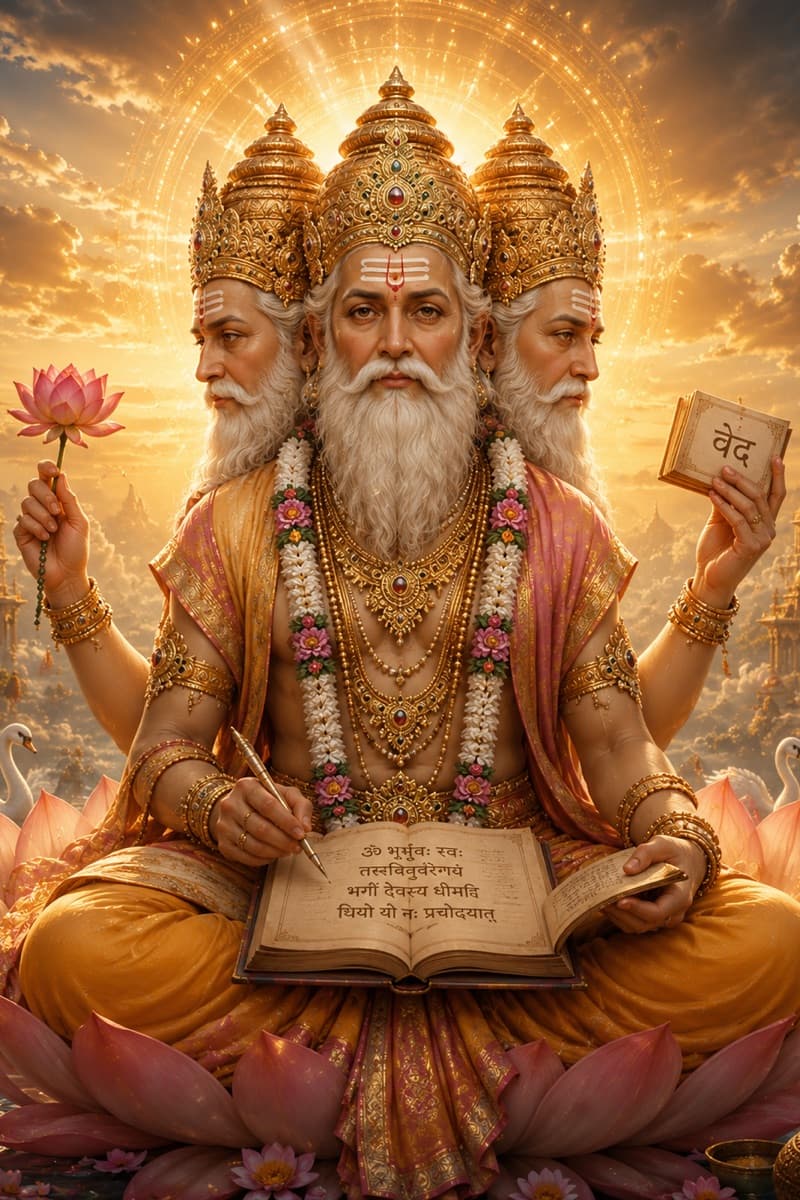
The Creator
Brahma
The four-headed god who set the universe itself into motion — the least worshipped of the Trimurti today, precisely because his work of creation was already finished at the beginning of time.
- consort
- Saraswati, goddess of knowledge
- symbol
- Four heads, the four Vedas
- vehicle
- Hamsa (the swan)
- role
- The creator, one of the Trimurti
Of the Trimurti — Brahma, Vishnu, Shiva — it is Brahma who performs the act every story needs before it can begin: creation itself. Seated on a lotus said to have risen from Vishnu's navel at the dawn of time, Brahma brought the universe, and all the beings within it, into existence.
Four Heads, Facing Every Direction
Brahma is depicted with four heads, one facing each cardinal direction — said to have grown so he could watch his own creation, Saraswati, from every angle after she tried to slip from his sight out of modesty. Each head recites one of the four Vedas continuously, an act of creation that never pauses even for a moment.
Consort of Saraswati
His consort is Saraswati, goddess of knowledge, music, and the arts — a fitting pairing, since a universe without wisdom to understand it would be creation left unfinished. Together they represent the twin acts that make existence meaningful: bringing the world into being, and giving it the capacity to know itself.
Why Brahma Is Rarely Worshipped Today
Unlike Vishnu and Shiva, who remain deeply active in ongoing worship, Brahma has very few dedicated temples in India today. Tradition offers several reasons — a curse for a moment of dishonesty, or simply that his singular task, creation, was completed once at the beginning of the universe and needs no further intervention, unlike Vishnu's continual preservation or Shiva's recurring cycles of destruction and renewal. Brahma's work was done at the very start — everything since has belonged to the other two.